The Scented-Candle Routine: When More Fragrance Is Not More Atmosphere
A scented-candle routine can make evenings feel calmer without scenting every corner: use light, sound and a familiar action to help the room settle.
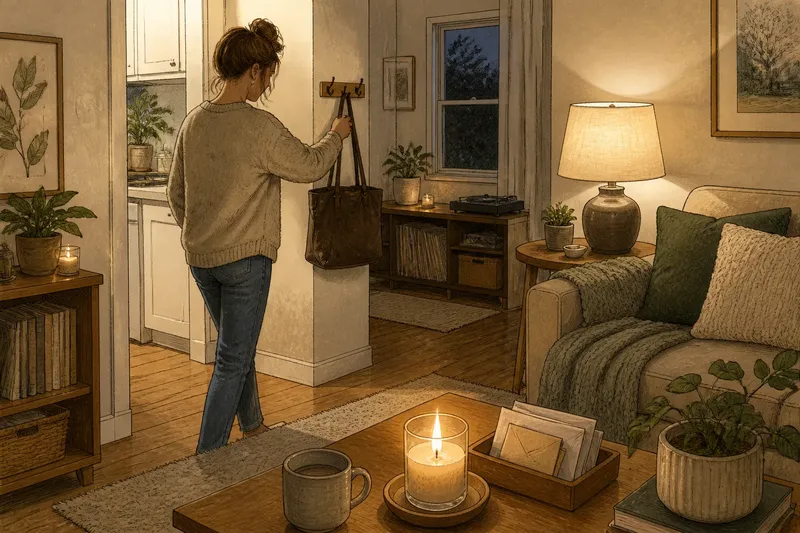
The common mistake with a scented-candle routine is adding another candle when a room still feels unsettled. The result can be a fragrance that crowds the air while the evening’s real friction—bright light, a rattling radiator, a pile of mail—remains untouched. A room can feel inviting without smelling strongly of anything.
Imagine Lena, arriving home to a small living room that feels more like a landing zone than a place to rest. She lights a citrus candle, then adds a second one when the scent seems to disappear into the kitchen. Soon the fragrance is the room’s loudest feature, but she is still standing under the ceiling light, checking messages and stepping around her work bag.
In this invented situation, Lena’s useful change is not finding a stronger scent. She makes a short settling-in ritual that gives her attention somewhere else to land: soften the light, put on a familiar piece of music, and do one small closing action before sitting down. The candle may remain, but it no longer has to manufacture the whole mood.
A candle cannot settle every part of the room
Fragrance acts quickly, so it is easy to mistake a noticeable smell for a welcoming atmosphere. Yet a room’s feel also comes from what the eye meets, what the ear catches, and whether the body can shift out of task mode. A lovely cedar scent cannot make a glaring bulb feel gentle or a half-finished chore disappear.
That does not make candles pointless. A familiar scent can be a pleasant cue, especially when it is subtle and used with intention. The trouble starts when each uncomfortable detail prompts another layer of fragrance. More scent can compete with dinner, fresh air, or the smell of the candle itself; it can also make the room feel less like a place to pause and more like a product display.
For Lena, the first useful question is not “What scent is missing?” but “What keeps me from settling?” She notices the overhead light, the phone in her hand, and the bag still beside the sofa. Naming those small interruptions makes the next action clearer.
Give the evening a cue that does not rely on scent
Lena chooses a compact sequence she can repeat without turning it into a project. She switches off the ceiling fixture and turns on a shaded table lamp. She sets her phone face down on a shelf, starts a familiar instrumental playlist at a low volume, and hangs her bag on its usual hook before sitting down.
The order matters less than the connection: these actions mark a transition from arriving to being home. The lamp changes the visual emphasis; the music gives the room a steady background; hanging the bag removes one unfinished task from her immediate view. Each cue does a different job, so no single one has to carry the mood.
Say Lena has only a few minutes before dinner. She skips the playlist, turns on the lamp, and places the mail in a tray rather than sorting it. The expected observable result is modest: the work bag is no longer in her path, the seating area is less brightly lit, and the mail is contained instead of spread across the table. She has not solved the whole evening; she has made a clear beginning to it.
Keep the candle as a quiet part of the routine
If Lena still enjoys the candle, she can choose one scent and treat it as an optional accent rather than a volume knob. A small candle on a stable, clear surface may be enough to register without competing with the room. She can also leave the candle unlit on evenings when food aromas, an open window, or a busy household already provide plenty for the senses.
Different materials and formats suit different preferences. A wax candle offers both fragrance and a visible flame; a flameless candle can provide a similar point of light without scent. A room spray brings fragrance without a sustained flame, while simply opening a window may be preferable when the air feels stale. These are distinct choices, not steps on a ladder toward a stronger atmosphere.
Keep candle use within the product’s instructions and ordinary fire-safety precautions: place it away from anything that can catch fire, and do not leave a lit candle unattended. What is not worth the effort is collecting several competing fragrances to cover every room or chore. That turns a settling cue into another thing to manage.
Notice what changes when the scent is quieter
Over several evenings, Lena pays attention to observable details rather than trying to judge whether the room feels “perfect.” Does she switch off the harsh light sooner? Does the room sound calmer with music, or does quiet suit her better? Does the bag still become a visual reminder of unfinished work?
Her answers can change from night to night. If music feels distracting, she leaves it off; if a candle’s scent dominates dinner, she saves it for another time. The ritual is useful precisely because it can be adjusted without buying anything or insisting that every evening follow the same script.
This approach also helps separate atmosphere from fragrance preference. Someone who loves a smoky or floral scent may still want a low-fragrance room at certain times. Someone who dislikes candles can use a lamp, a familiar kettle sound, or the act of drawing the curtains as a transition cue. The point is not to imitate Lena’s routine but to notice which small action makes the room easier to inhabit.
Which part of a scented-candle routine matters most?
Does a stronger candle make a room feel more welcoming?
Not necessarily: a strong scent can take over while lighting, noise, or visible clutter still feels distracting. A subtler candle paired with one helpful change may suit the room better.
What can replace a candle in an evening ritual?
Try a shaded lamp, a familiar song, drawing the curtains, or putting away one item that signals the workday is over. Choose a cue that feels easy rather than adding a new task.
Should the same scent be used every evening?
Only if it remains pleasant and appropriate for the moment. Food, fresh air, and other household smells can make a candle unnecessary, and a scent-free evening can be part of the routine too.
How can I tell whether the ritual is helping?
Look for a small, concrete shift: you sit down sooner, stop adjusting the lights, or no longer feel pulled toward the work bag. If the sequence becomes another obligation, simplify it.
Let the room settle without asking fragrance to do everything
By the end of Lena’s imagined routine, the candle is no longer the main event. The lamp defines a softer corner, the bag has a place, and music—or quiet—helps signal that she can stop arriving and start resting. The fragrance stays optional, which makes it easier to enjoy when she wants it.
A scented-candle routine works best when it belongs to a larger, gentle transition rather than serving as a cure for every awkward feeling in a room. Start with one action you can see or hear, keep the scent comfortable, and let the room’s own details tell you what would help next. Sometimes the most inviting change is simply giving yourself permission to sit down before lighting anything.